Lonestardigital.com

Site Directory

Home Page
About / Contact
Site Search / Links

Photoshop Articles & Tutorials

Auto Contrast
Better Blue Sky
Crooked Pictures
Photoshop Tips
Haze Removal
History Brush
Hot-Key Action
Lonestar USA Action
Perspective Correction
Rubber Stamp Tool
Skin Tone Correction
Smart Blur
Unsharp Mask + Fade

Miscellaneous Articles

Action Photography
Aperture Diffraction
D1X Mystery Pixels
D2H Skin Tones
D30 & D60 Color Fix
LCD Viewfinder Ideas
Multiplier Effect
Nikon D1 Color Fix
Printing & Processing
QM Pro for Noise
Why Shoot Raw?

Digital SLR
Camera Reviews

Contax N Digital
Canon EOS D30
Canon EOS 1D
Fuji S1 Pro
Fuji S2 Pro
Kodak DCS 315
Kodak DCS 620
Kodak DCS 620x
Kodak DCS 760
Kodak DCS Pro14n
Kodak 645M ProBack Nikon D100
Nikon D1 / D1H / D1X
Nikon D2H
Nikon D2X
Olympus E1

Point & Shoot
Camera Reviews

Agfa ePhoto 1680
Nikon Coolpix 700
Nikon Coolpix 800
Nikon Coolpix 900
Nikon Coolpix 950
Nikon Coolpix 990
Nikon Coolpix 995
Nikon Coolpix 5700

Other Reviews

Flash Accessories
Kodak 8500 Printer
Olympus P-11 Printer
Sigma 50-500 Lens

Best viewed at 1024 x 768 or greater screen resolution, 16 bit color or better.
All content & photographs copyrighted, all rights reserved.

Photoshop Tutorial

Better Blue Sky with the Gradient Tool

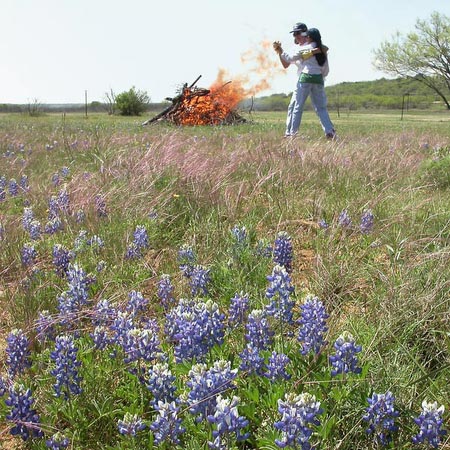
There I was, on my knees at ground level, taking a closeup of some Texas Bluebonnets while the girls were working out in the field clearing brush & burning deadwood. The boom box was playing in the background, Willie Nelson & the boys at their best. I looked up and saw something special - my wife was teaching our daughter how to dance the Texas Two-Step. I tilted the camera up and squeezed off a snapshot.

I loved the picture ... I only wished that the sky looked as blue as it did in real life. But that's what frequently happens with outdoor photography. If the foreground is exposed properly, the sky becomes faded, gray, or white from overexposure.

Texas Two-Step
Nikon Coolpix 4500 snapshot

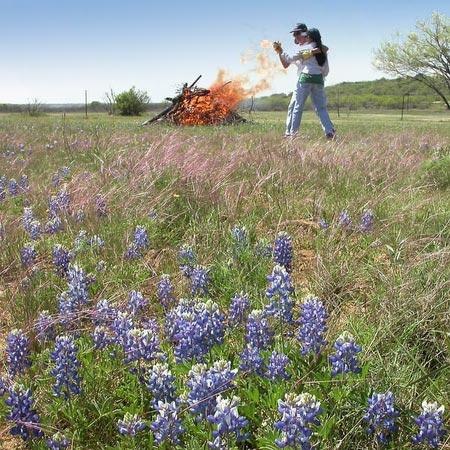
Put the blue back into the sky with a simple two step process.

(Below) Here's the same picture with a natural looking blue sky, achieved with a relatively simple two step process in Adobe Photoshop. Note that the blue is darker at the top, fading away as it reaches ground level, just the way Mother Nature does it.

Texas Two-Step w/Blue Sky

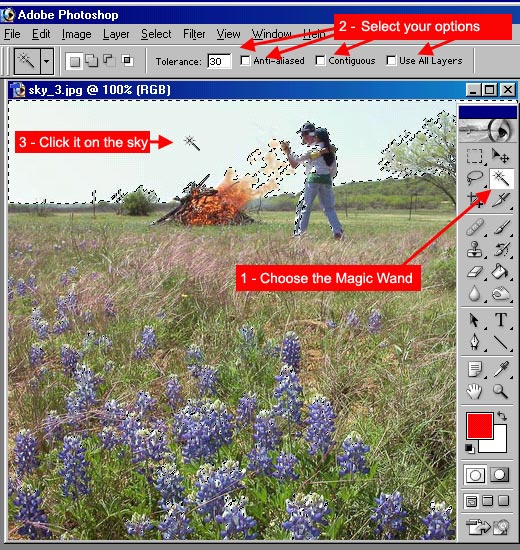
First step - The Magic Wand Tool.

  • Click on the Magic Wand Tool in Photoshop's Toolbar.
  • Set the Tolerance to 30.
  • Uncheck the Contiguous box. This allows the Magic Wand to pick up the sky within tree limbs, leaves, telephone poles or other obstructions in the sky. Note: It doesn't matter if the Magic Wand picks up other areas in the lower part of the picture, what's important is that the entire sky gets selected.
  • Uncheck the Anti-aliased box. Otherwise the gradient will tint the edges on objects within the sky.
  • Uncheck the Use All layers box.
  • Click the magic wand tool on the sky. If there are clouds present, click the sky, not the clouds. If some of the sky doesn't get picked up on the first click, hold the Shift Key down while you do some more clicks on the unselected areas until the whole sky is selected.

Magic Wand

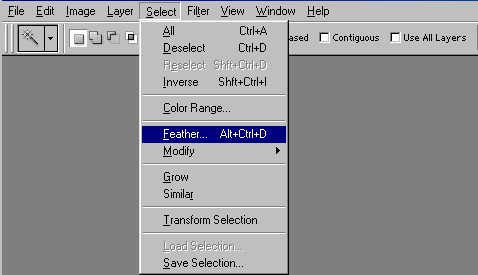
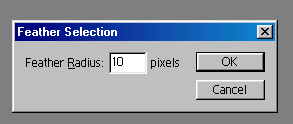
  • Now feather the selection 10 pixels.
    This will smooth the sky to edges transition areas.

Select Feather

Feather 10 Pixels

Second step - The Gradient Tool.

  • Click on the Gradient Tool in Photoshop's Toolbar.
  • Select Foreground to Transparent. Clicking on the little down arrow on the right side of the box shown below the "Image Layer Select" part of the Photoshop menu bar will drop down the field of choices. (Click the down arrow again to retract it.)
  • Check the Reverse box (makes it go from transparent to colored.)
  • Check the Dither box (makes the fade smoother & more natural looking.)
  • Check the Transparency box (retains a natural look so it doesn't look painted-on.)
  • Set the Opacity at 25% to 50%. Higher percentages produce bluer skies, but can look too stiff. Start out with 25% and see how that works first.

Gradient Tool

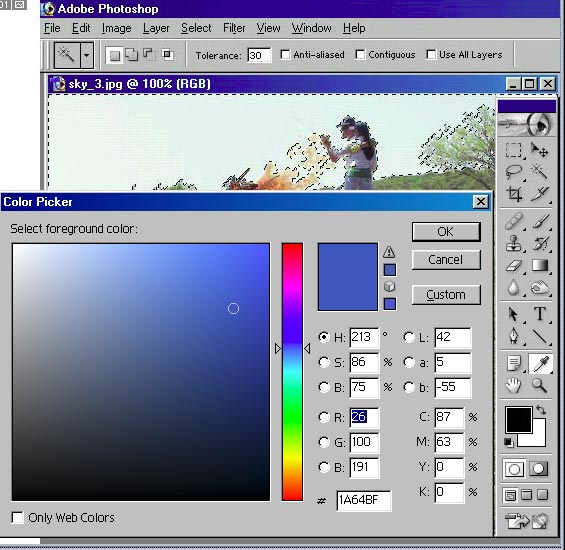
Next pick a natural blue sky-like color to use for the Gradient.

  • Click on the foreground color box (the top one of the twin color boxes) located in the bottom section of the toolbar, the Color Picker will pop up on your screen. Slide the slider to the blue range and click on a foreground color that is rich-blue-skylike. (Example shown below.)
  • Tip: If you like the way a particular blue setting works for your skies, you can use the same # number on the Color Picker screen (1A64BF is my favorite sky blue) and just type it in the box any time you open the Color Picker. This will set all the numbers (and the resulting color) the same every time.

Color Picker

Apply the Gradient.

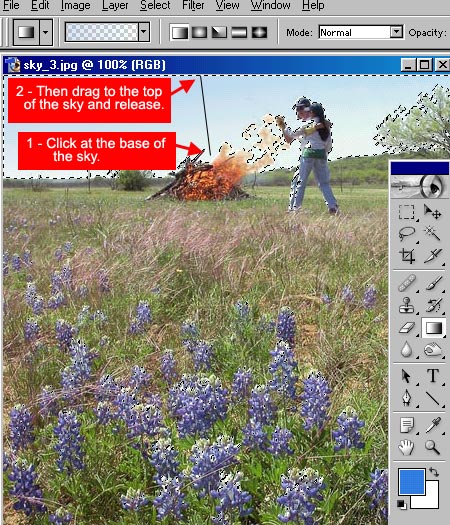
  • Click on the Gradient Tool again, put the mouse cursor on the bottom of the sky, hold the mouse button down as you drag the cursor to the top of the sky, then release the mouse button. Sometimes a slight angle as you drag your mouse (like the one shown below) will produce an even more natural look. Take one pass only. If you want more or less blue, back up (undo) a step and increase or decrease the opacity percentage 5% at a time until you get the look you want.

 Applying the Gradient Tool


  • Then Deselect the sky (Select / Deselect in the dropdown menu).
  • Done. Save it as a different file name to you retain your original.
  • If you're printing the picture, try a stronger opacity percentage of Gradient fill. A rich blue sky is especially dramatic in print.