|
|
|
The
"Multiplier Factor" ... also
called the "Crop
Factor" Digital
Single Lens Reflex cameras
(DSLRs) use an electronic
sensor instead of film to
capture a picture.
Most
sensors are smaller than a
frame of traditional 35 mm
film, but all sensors and film
planes are mounted in the same
relative position. As a
result, images projected
through the lens onto the back
of the camera are physically
larger than those
smaller-than-full-frame sized
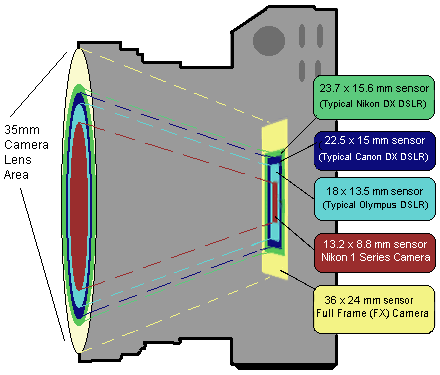
digital sensors. When that
happens, only the center
portion of the total image
is captured by the
sensor. The
illustration
at left
shows the
relative
size
differences
of different
sensors on
the exposure
plane and
their
associated
areas of
image
capture. The
outer
portions of
the total
image are
cropped away
in varying
amounts by
the smaller
sensors. The
cropped
capture area
has a
reduced
field of
view,
creating
what is
often called
a
"multiplier
factor". The
multiplier
factor is
used to
compare the
practical
focal length
of a lens on
a Digital
SLR to a
full frame
camera.
Because of
the cropped
view, the
listed focal
lengths of
all lenses
used on
digital
cameras with
sensors
smaller than
a full frame
must be
adjusted by
the
"multiplier
factor" to
calculate
the longer
practical
focal
lengths with
their
associated
reduced
fields of
view.
Canon
DX Format
Cameras Calculating
the practical focal
length Take
the focal length of
any given lens and
multiply it by the
multiplier factor to
get the practical
(cropped view) focal
length for the camera
in question. For
example, an 18 mm
focal length lens
produces a field of
view like a 24 mm
lens on a Nikon D70
(18 mm x 1.5
multiplier), while a
200 mm lens on a
Canon 20D has a field
of view like a 320 mm
lens (200 x 1.6
multiplier). Some
call it a
telephoto-like
effect. Example
of the cropped field
of view and its
associated multiplier
factor The
picture set below
shows the relative
differences in the
fields of view
between a full frame
camera and a DSLR
camera with a 1.5x
multiplier
factor. 400
mm
telephoto
lens
view
of
an
airplane
in
flight
as
seen
through
the
viewfinder
of
a
full
frame
camera. The
reduced
field
of
view
cropped
by
a
1.5x
multiplier
sensor
is
shown
inside
the
red
border. The
cropped
1.5x
view
produces
a
600
mm
effective
view
(when
compared
to
a
full
frame
camera). Just
as
"zooming
in"
is
a
result
of
increased
real
focal
length,
the
cropped
area
created
by
the
multiplier
factor
increases
the
perceived
(practical)
focal
length
of
the
lens.
Objects
look
closer
because
they
are
in
a
cropped
viewing
area.
Why
is the crop
factor
(multiplier
factor)
important? Experienced
photographers
buy and use
their lenses
according to
focal length
(wide angle
through
telephoto),
and speed
(aperture
rating).
Speed refers
to "fast"
lenses (low
base
aperture
numbers)
compared to
"slow"
lenses
(higher base
aperture
numbers).
Fast lenses
are higher
quality
(more
expensive),
and give a
broader
range of use
under
different
lighting
conditions.
(Fast is
desirable.) |

.jpg)
.jpg)
.jpg)